

Quick Summary: Violence at Work Is a Board-Level Risk in 2026
Workplace violence is no longer a sector-specific problem confined to A&E waiting rooms and convenience stores at closing time. HSE's Labour Force Survey now records around 689,000 incidents of work-related violence a year in Great Britain. The latest NHS Staff Survey shows the highest rate of physical violence against staff in three years. The British Retail Consortium's 2026 Crime Report puts abuse of shopworkers at roughly 1,600 incidents a day, with 36 of those involving a weapon. Parliament has just passed the Crime and Policing Act 2026, which creates a standalone offence of assaulting a retail worker. This guide sets out what UK employers need to understand about the scale, the law, and the operational response, whatever sector you are in.
What "Violence and Aggression" Actually Covers
HSE's working definition is broad on purpose. It covers any incident in which a person is abused, threatened or assaulted in circumstances relating to their work. That includes verbal abuse, threats made over the phone or online, intimidation, racial and sexual harassment, physical assault, and the use or threat of weapons. The legal exposure for employers is not limited to incidents that put someone in hospital. A pattern of verbal abuse that an employer knew about and failed to address can be enough to demonstrate a breach of duty.
The first operational problem most employers face is not response. It is reporting. Verbal abuse and threats are routinely under-reported because the friction of filling in a form is higher than the cost of just absorbing the incident and moving on. The result is that leadership sees the assaults, but lives with a wildly incomplete picture of the precursor behaviour that would have predicted them.
The 2026 Legal Picture Every Employer Needs to Grasp
UK employers carry a general duty under the Health and Safety at Work etc Act 1974 to ensure, so far as reasonably practicable, the health, safety and welfare of their employees. The Management of Health and Safety at Work Regulations 1999 translate that duty into specifics: a suitable and sufficient risk assessment, including for the risk of violence, and adequate control measures. For lone workers, those control measures include systems to keep in regular contact and to raise an alarm in an emergency.
Several pieces of more recent legislation have raised the bar:
- The Worker Protection (Amendment of Equality Act 2010) Act 2023 came into force on 26 October 2024. It introduced a new preventative duty on employers to take reasonable steps to prevent sexual harassment of employees, including harassment by third parties such as customers, patients and suppliers. The Equality and Human Rights Commission can enforce this duty even where no individual complaint has been raised.
- The Crime and Policing Act 2026 received Royal Assent on 29 April 2026. It creates a standalone offence of assaulting a retail worker, carrying a maximum of six months in prison and an unlimited fine, with a presumption that courts will impose a Criminal Behaviour Order on first conviction. The Act is being commenced in stages over 2026.
- The Corporate Manslaughter and Corporate Homicide Act 2007 continues to expose senior leaders where a gross breach of duty contributes to a worker's death. Violence incidents are squarely in scope.
Sector-specific frameworks sit on top of this. NHS England published a refreshed Violence Prevention and Reduction Standard in December 2024, which all integrated care boards and NHS-funded providers are expected to implement and self-assess against. BS 8484:2022 remains the British Standard for lone worker safety services and is now the buying benchmark for any organisation putting protective devices or apps in the hands of staff.
Which Workers Are Most Exposed
The risk is unevenly distributed. Five workforces are carrying most of the weight.
Retail. The BRC's 2026 Crime Report estimates 1,600 incidents of violence or abuse against shopworkers a day across the UK, including 118 incidents a day involving physical violence and 36 involving a weapon. USDAW's 2026 Freedom from Fear survey of nearly 9,000 retail staff found that close to 80% had been verbally abused in the past year and more than half had been threatened on shift.
NHS frontline. The 2025 NHS Staff Survey shows 14.47% of staff experienced at least one act of physical violence from patients, families or the public, the highest figure in three years. A quarter experienced harassment or abuse. Among ambulance staff, the figure for physical violence rises to 52%, and almost one in three reported unwanted sexual behaviour from patients or the public.
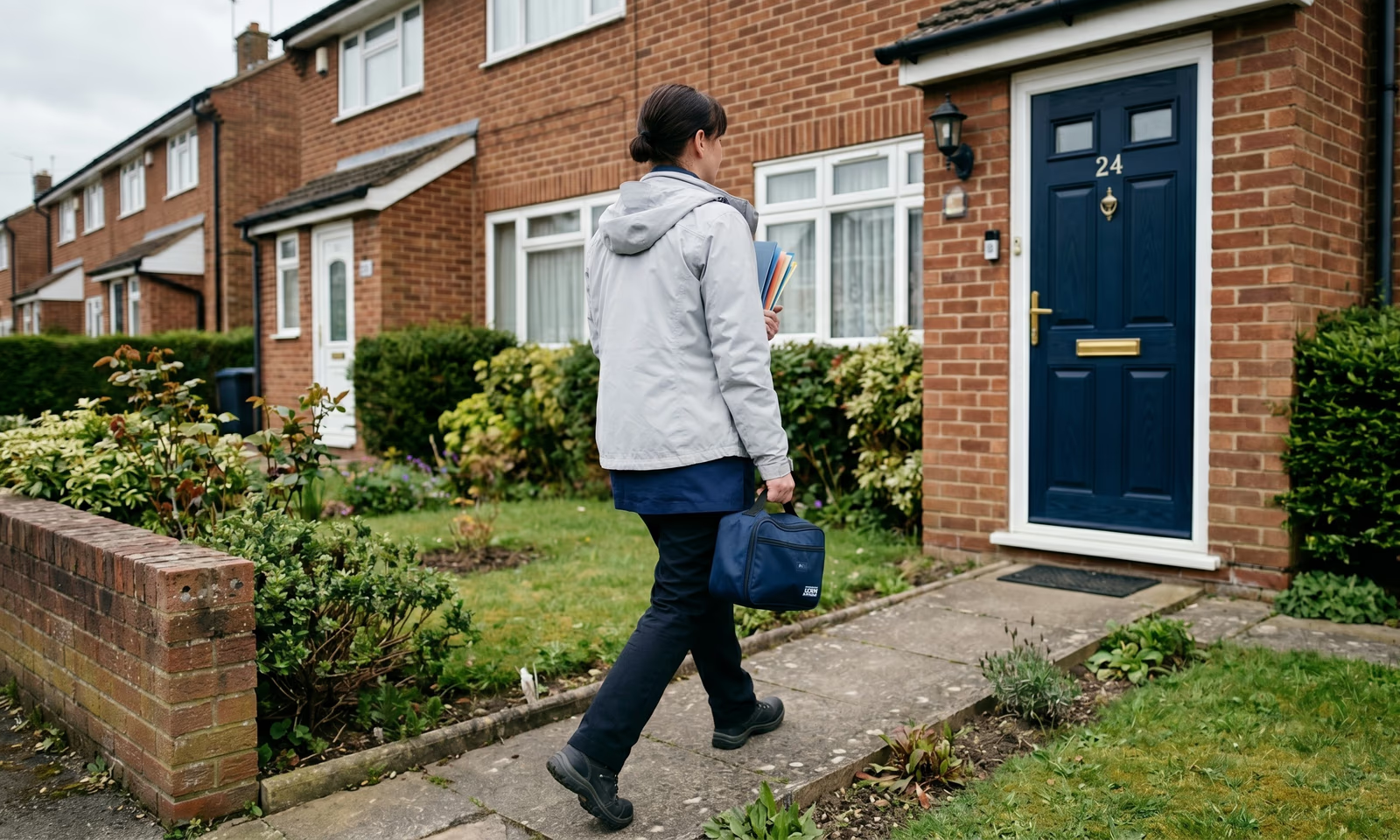
Social care and domiciliary visits. Care workers visiting service users at home face the same patient population as community health staff, but without on-site colleagues or security. Verbal abuse from family members during safeguarding situations is routine. Lone-working dynamics make even low-level aggression harder to absorb safely.
Social housing. Inside Housing's reporting has consistently found that housing officers face assaults, threats with weapons, and sustained psychological abuse during arrears visits, anti-social-behaviour interventions and eviction proceedings. Officers report that lower-level violence is often treated as part of the job, which has the effect of suppressing the data needed to do something about it.
Field service, transport and security. Utility engineers, transport staff, parking enforcement, traffic wardens and security officers are routinely the visible point of contact for decisions other people made. They tend to work alone, in public, and often outside core hours.
The Five Things UK Employers Need to Have in Place
A defensible response to workplace violence rests on five operational components. None of them is optional, and most of them fall down because they were designed once and never refreshed.
1. A risk assessment that names violence as a hazard by role. Generic site-level risk assessments are not enough. The role most exposed to verbal abuse in your organisation is rarely the role with the formal "lone worker" label. List the roles, the locations, the times of day, and the precursor behaviours you already know about.
2. A current violence and aggression policy that staff have read. A policy on a SharePoint site that nobody has opened since induction is not a control. Read and Understood needs to be evidenced, especially for new hires and after every policy change.
3. Reporting that is fast enough to use in the moment. If your reporting form takes ten minutes to fill in after a shift, you will only ever see the assaults. The verbal abuse, threats and racial harassment will quietly disappear into the gap between "report this" and "go home and forget it". Mobile-first, low-friction incident capture is the difference between a real picture and a flattering one.
4. A response capability the worker can actually trigger. For lone or public-facing staff this means a panic alarm or app capable of raising an alert without needing to be unlocked, GPS location shared with a monitored response, and an escalation path that does not depend on a colleague answering their phone. BS 8484:2022 accredited 24/7 Alarm Receiving Centre monitoring is the standard buyers should be asking for.
5. A learning loop that turns incidents into change. Trend analysis by site, by role, by time of day, and by repeat aggressor. Action ownership with named deadlines. Policy and training updates that close the loop. Without this layer, every report is just a record of harm that already happened.
Why Most Reporting Systems Quietly Fail Here
Across our customer base, the same pattern shows up before they switch. Incidents are captured in a paper logbook on a counter or a desk, on an email inbox that one person owns, in a WhatsApp group that no one is reading on weekends, or in a spreadsheet that nobody can run a report from. None of these tools survive contact with a verbally abusive customer at the end of a long shift.
The under-reporting that follows is not a culture problem first. It is a tooling problem first, which then becomes a culture problem. When staff report something and nothing visibly happens, they stop reporting. When leadership sees only the serious end of the tail, the prevention budget gets cut because "we don't have a violence problem". The cycle is self-reinforcing.
This is the same pattern we covered in our piece on near-miss reporting errors that skew your safety data, and it shows up even more sharply with violence, because the social cost of reporting is higher.
Building a Defensible Response
The organisations getting this right run the same closed loop, regardless of sector. A worker reports an incident on a mobile app, in seconds, including verbal abuse. The system routes it automatically to the right manager based on site, role and severity. Corrective actions are created with owners and deadlines. Trends are visible in real time at site, regional and board level. Lone or public-facing staff carry a BS 8484:2022 accredited device or app linked to 24/7 monitored response. Policy and training updates are evidenced through Read and Understood, with a clear audit trail for HSE, CQC or insurer review.
This is what Vatix's employee safety platform is built to support. The same platform captures the incident, manages the follow-up actions, runs the violence and aggression risk assessment, holds the policy that staff have read and acknowledged, and provides the analytics that turn fragmented reports into a board-level picture of risk. For lone and public-facing staff, the Vatix lone worker app and Safe Pro device add a BS 8484:2022 accredited 24/7 response on top of the same platform, so an alert raised in the moment becomes an incident, an action, and a trend in one record.
Get Ahead of Workplace Violence
Get in touch and we will show you how Vatix captures violence and aggression incidents the moment they happen, escalates them through your response protocol, and turns them into the prevention data your board is asking for.