

Quick Summary: Why Your Safety Data Might Be Lying
Safety data serves as the foundation for proactive risk management, yet inaccurate near-miss reporting often creates a dangerous illusion of security. When frontline hazards go unrecorded or are classified incorrectly, safety managers lose the ability to predict and prevent serious injuries. This comprehensive guide identifies the primary pitfalls that compromise data integrity and provides actionable strategies to ensure your safety metrics reflect reality.
The Hidden Danger of Skewed Near-Miss Data
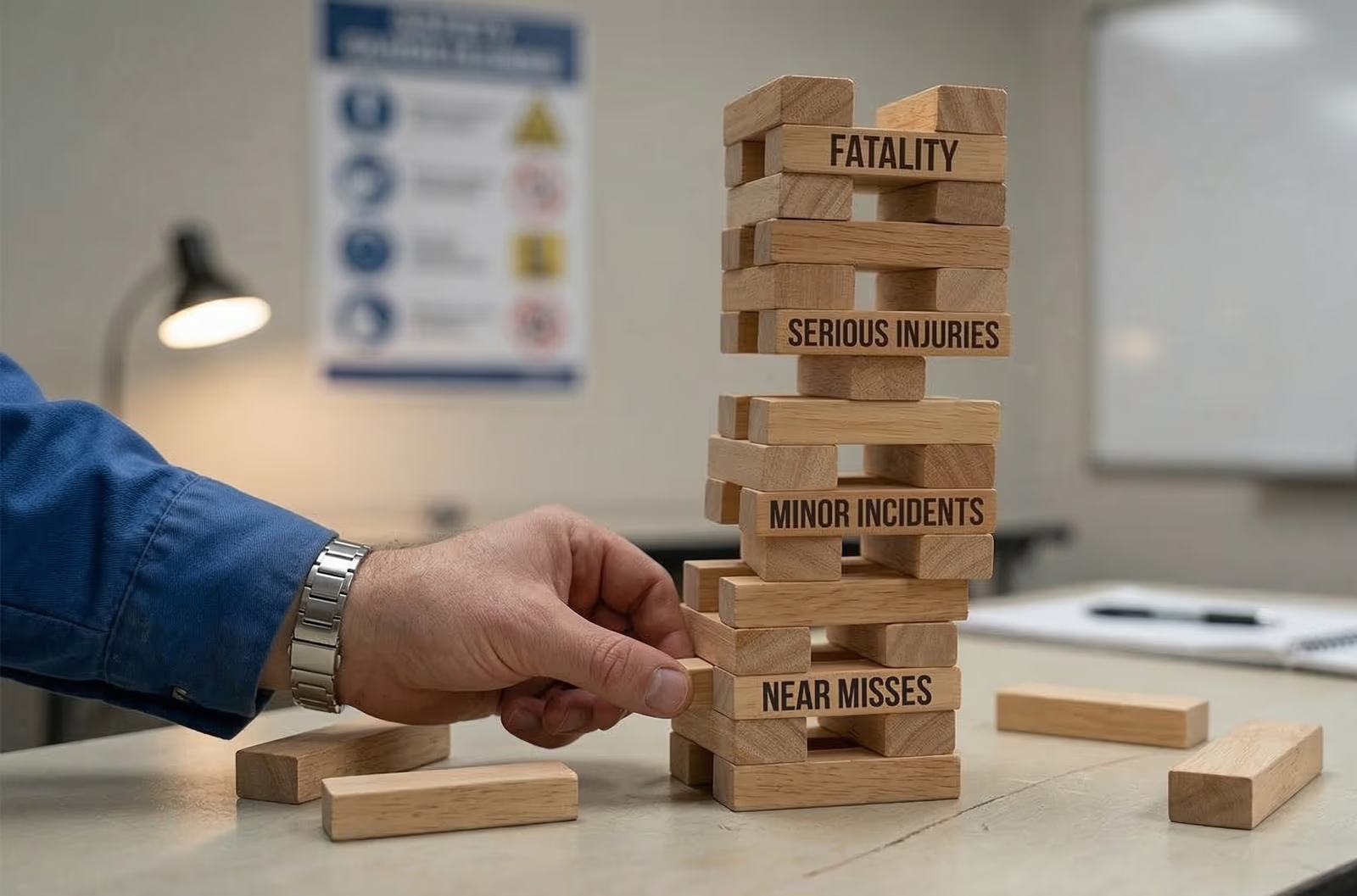
Inaccurate safety data prevents organisations from identifying high-risk areas before they escalate into lost-time incidents or fatalities. Research into workplace safety, including Herbert Heinrich's foundational work on the "safety pyramid," highlights that for every serious accident, there are typically many more near misses that, if reported correctly, could provide the necessary warning signs. Relying on skewed data leads to misallocated resources and a false sense of compliance that leaves workers vulnerable to known but unrecorded hazards.
Error 1: The Incident vs. Near-Miss Definition Gap
A near miss is an unplanned event that did not result in injury, illness, or damage—but had the potential to do so. Many employees fail to report near misses because they cannot distinguish them from minor inconveniences or actual incidents. Without clear internal definitions, high-potential events are often ignored, leaving the business blind to recurring systemic failures.
To bridge this gap, managers must provide clear, visual examples of what constitutes a reportable event. Training should emphasise how to report a near miss to improve workplace health and safety so that employees feel confident identifying close calls. When staff understand that a near miss is a valuable early warning rather than a non-event, the volume of high-quality data increases, allowing for more robust predictive modelling.
Incident: An event resulting in harm or damage. For example, a worker trips over a cable and breaks their wrist.
Near Miss: An event with potential for harm that didn't result in injury. For example, a worker trips over a cable but regains balance.
Hazard: A condition with potential for harm. For example, a loose cable stretched across a high-traffic walkway.
Error 2: Psychological Bias and the Fear of Reprisal
Employees frequently withhold near-miss reports when they perceive that reporting will lead to disciplinary action or increased scrutiny. Academic research on safety culture consistently demonstrates that "blame cultures" correlate with high rates of underreporting, specifically for events involving human error. When workers fear for their job security, they tend to only report incidents that are too visible to hide, skewing the data toward lagging indicators.
Organisations that implement anonymous or non-punitive reporting channels typically see significant increases in reported near misses. By shifting the focus from "who did it" to "what happened," companies can foster a transparent environment where safety is a shared responsibility. Eliminating fear is the most effective way to identify underreporting within specific departments or shifts.
Error 3: The Reporting Lag and Memory Decay
The accuracy of safety data diminishes rapidly as the time between the event and the report increases. Research into eyewitness memory and incident recall indicates that details fade quickly—memories become less complete and more susceptible to error within hours of an event. When employees wait until the end of a shift or week to log events, critical details like weather conditions, equipment settings, or exact locations are often lost or reconstructed inaccurately.
This decay creates significant incident reporting bottlenecks that prevent safety teams from performing effective root cause analysis. Implementing mobile-first reporting solutions allows workers to capture data at the point of interest, including photos and GPS coordinates. Real-time data entry ensures that the information being analysed is an accurate reflection of the event rather than a reconstructed memory.
Error 4: Inconsistent Categorisation and Subjectivity
Subjective data entry occurs when different employees use varying terms to describe identical hazards, making it impossible to aggregate data for trend analysis. Without standardised dropdown menus, the same type of hazard can be categorised in numerous different ways across different teams. This lack of standardisation prevents safety software from identifying "hot spots" where multiple near misses are occurring for the same underlying reason.
To maintain data integrity, organisations should utilise a near-miss reporting checklist to standardise inputs across all departments. By limiting open-text fields and using predefined categories for "Root Cause" and "Hazard Type," safety managers can generate clean data sets. This structure is essential for accurate KPI reporting and for meeting the rigorous requirements of standards like ISO 45001 for occupational health and safety management.
Error 5: Manual Data Silos and Lack of Integration
Manual reporting systems, such as paper forms or disconnected spreadsheets, create data silos that hide the true risk profile of an organisation. Manual data entry introduces transcription errors that further corrupt the safety database. When near-miss data is not integrated with other risk management tools, managers cannot see the correlation between near misses and broader operational failures.
Utilising a unified near-miss reporting software platform eliminates these silos by centralising all safety data in a single, accessible location. Digital integration allows for automatic alerts and real-time dashboard updates, ensuring that safety trends are visible to stakeholders at all levels. This transparency ensures that safety data is treated as a strategic asset rather than a forgotten administrative task.
Safety Manager's Toolkit: How to Clean Skewed Data and Visualise Trends
Cleaning skewed data begins with a thorough audit of historical reports to identify patterns of underreporting or miscategorisation. A useful check is to compare near-miss volumes against minor injury rates; a healthy safety reporting culture typically shows significantly more near misses than injuries—this aligns with the ratios suggested by Heinrich's safety pyramid. If your data shows the opposite, it is a primary indicator of a reporting error or a cultural barrier.
Once the data is cleaned, safety managers should focus on visualising high-potential (HiPo) trends. Visual tools like heat maps can pinpoint geographical clusters of near misses, while Pareto charts can identify the top 20% of hazards causing 80% of the risk. Moving toward analysing near-miss data for safety trends requires a shift from descriptive analytics (what happened) to predictive analytics (what will happen).
Frequently Asked Questions About Near-Miss Reporting
What is an example of a near-miss error?
A common example is "category drift," where a high-potential near miss (like a falling object that narrowly missed a worker) is reported as a simple "housekeeping issue" because it is easier to resolve.
What is the most common near-miss incident?
Slips, trips, and falls remain among the most common near-miss incidents across UK industries, though they are also likely to be underreported due to their perceived "triviality."
What is a near miss in safety reporting?
It is any event that had the potential to cause injury or damage but was interrupted by chance or timely intervention. In a robust safety system, these are treated with the same investigative rigour as actual accidents.
The Limits of Reporting: When Data Isn't Enough
While accurate data is vital, it cannot replace physical site inspections and direct employee engagement. Numbers can tell you "where" and "how often," but they rarely tell you the complete "why" behind human behaviour. Even the most sophisticated safety software requires a human element to interpret the nuances of workplace dynamics and the subtle pressures that lead to shortcuts.
Effective safety management combines data-driven insights with a visible presence on the shop floor. By validating reported data through regular audits and safety walks, managers ensure that the digital record matches the physical reality of the workplace. This holistic approach ensures that near-miss reporting is a tool for active protection rather than just a compliance checkbox.
Conclusion: Turning Data into Protection
Eliminating reporting errors is the first step toward building a truly proactive safety culture. By standardising definitions, removing psychological barriers, and adopting digital tools, UK businesses can transform skewed safety data into a powerful shield for their workforce.
If you're ready to take control of your safety metrics, book a demo with Vatix to see how our platform can help you capture cleaner data and spot risks before they escalate.