

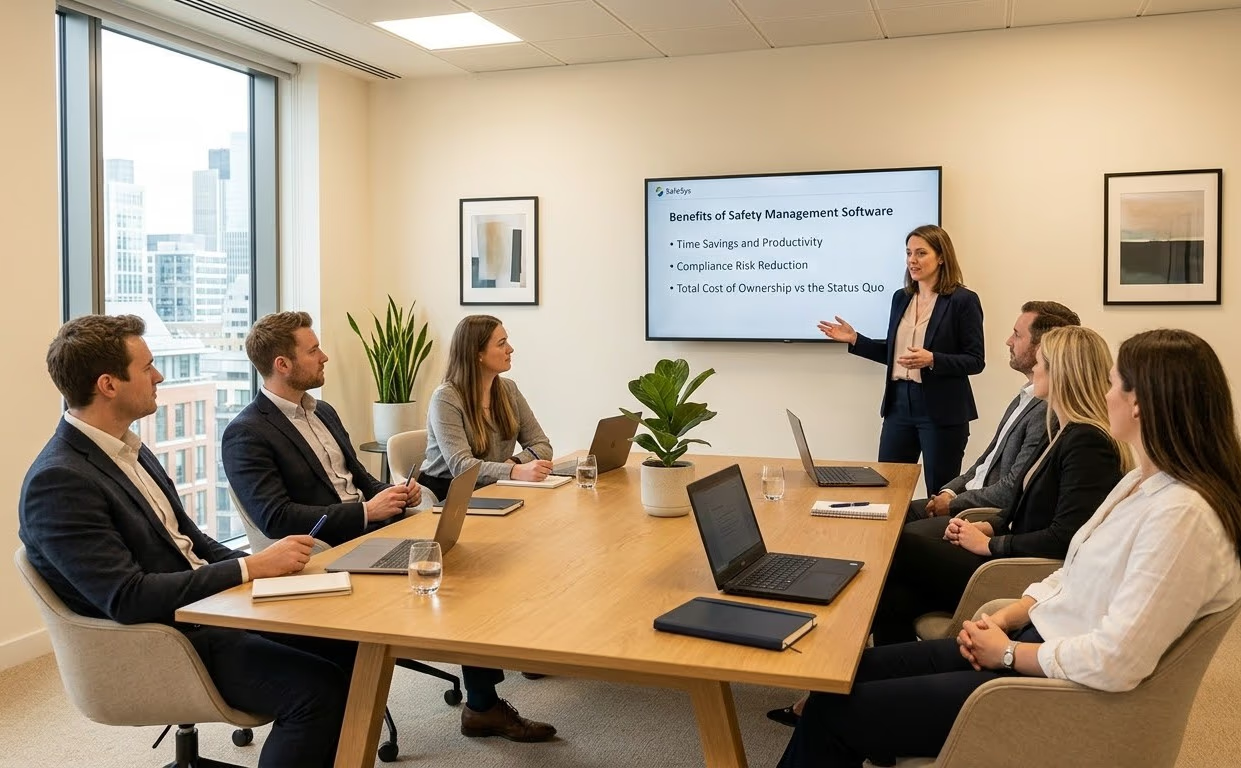
Key Takeaway The strongest business cases for safety management software are built on three pillars: quantified time savings (customers report up to 70% reduction in admin time), compliance risk expressed in financial terms (average HSE prosecution fines exceed £30,000), and total cost of ownership compared against the status quo. Leadership does not approve tools. They approve investments with measurable returns.
You know the platform will transform how your team works. You have seen the demos. You have shortlisted your vendors. But none of that matters until you can walk into a boardroom and show your COO or Finance Director why this investment pays for itself.
This is the step most EHS professionals find hardest. You are an expert in safety, not in writing business cases. The board does not want to hear about configurable forms or mobile reporting. They want to know what it costs, what it saves, and what happens if you do nothing.
This article gives you the framework, the numbers, and the structure to make that case.
Why Most Business Cases for EHS Software Fail
Before building the case, understand why they get rejected.
Leading with features, not outcomes. "It has mobile reporting and automated workflows" is a product pitch. "It will reduce our safety admin by 70% and reclaim 1,600 hours a year for strategic work" is a business case. Your leadership team does not care about the software. They care about what changes when you have it.
Ignoring the cost of doing nothing. Every business case competes against the status quo. If you do not quantify what spreadsheets and manual processes actually cost, your proposal looks like a net new expense rather than an investment that eliminates a larger hidden cost.
Presenting a single number without context. "It costs X per year" means nothing without a comparison. But that same figure set against tens of thousands in reclaimed productivity and the risk of a £30,000+ prosecution fine is a very different conversation.
The Three Pillars of an EHS Software Business Case
Every successful business case for safety management software rests on three arguments. You do not need all three to be overwhelming, but you need all three to be present.
Pillar 1: Time Savings and Productivity
This is your strongest argument. Safety teams on manual processes (spreadsheets, paper forms, email-based action tracking) spend a disproportionate amount of their time on administration rather than the strategic safety work they were hired to do.
The benchmark: Vatix customers have measured a 70% reduction in administrative time after moving to the platform. That figure comes from verified customer feedback and is the single most powerful number in your business case.
How to calculate it for your organisation:
Start by auditing your team's weekly time on manual processes. Be honest and specific. Here is a framework:
| Cost category | Spreadsheets / manual | Connected platform |
|---|---|---|
| Admin time | 45+ hours/week (3 staff) | ~13.5 hours/week |
| Configuration changes | N/A (rebuild from scratch) | Free (self-serve Object Manager) |
| Tools maintained | 3–7 disconnected tools | One platform |
| Vendor contracts | Multiple | One |
| Training | Multiple systems | One system |
| Data integration | Manual re-entry | Native (closed loop) |
| Audit trail | None (or incomplete) | Automatic |
| Board reporting | 8–16 hours/month (manual) | Real-time dashboards |
Worked example for a mid-market organisation (3 EHS staff, 20 platform users):
- Weekly admin time before platform: 45 hours (3 staff × 15 hours each)
- Weekly admin time after platform (70% reduction): 13.5 hours
- Hours reclaimed per year: 1,638 hours
- Value at £35/hour (average EHS professional cost): £57,330 per year
Now compare that figure against the annual cost of your shortlisted platform. For most mid-market teams, the payback period is measured in weeks, not months. That is the number your board needs to see.
Key Takeaway When presenting time savings to leadership, express them in pounds, not hours. The board does not budget in hours. A 70% reduction in admin time is impressive, but £57,000 in reclaimed productivity against a fraction of that cost in platform licensing is a decision.
Pillar 2: Compliance Risk Reduction
Time savings alone may be enough. But coupling them with compliance risk reduction makes the case substantially harder to reject.
The regulatory exposure:
- Average HSE prosecution fine for health and safety offences: over £30,000
- Corporate manslaughter convictions carry unlimited fines
- RIDDOR non-compliance is a criminal offence
- ISO 45001 certification is increasingly required for supply chain participation
- Post-incident investigation without an audit trail creates significant legal exposure
The framing that works: Do not present compliance as an abstract risk. Quantify it. "If an incident occurs tomorrow and HSE investigates, can we demonstrate a documented learning loop from incident through corrective action to policy update to audit verification? If the answer is no, we are exposed."
The closed loop (incident triggers action, action updates the risk register, risk assessment generates a document, document is distributed for acknowledgement, audits verify compliance, analytics reveal patterns) is exactly what regulators want to see. A connected platform creates that evidence trail automatically. Spreadsheets do not.
For your board presentation: Frame the platform cost as an insurance premium. "A single HSE prosecution averages over £30,000, before legal costs, operational disruption, and reputational damage. The platform does not just reduce admin. It creates the defensible audit trail that protects the organisation, at a fraction of that exposure."
Pillar 3: Total Cost of Ownership vs the Status Quo
The third pillar is the comparison that puts it all together. Your board will ask: "What are we spending now, and how does this compare?"
The hidden cost of the current state:
| Process | Typical time (manual) | Typical time (with platform) | Saving |
|---|---|---|---|
| Incident reporting (per report) | 15–30 minutes | 2–5 minutes | ~80% |
| Monthly board report compilation | 8–16 hours | 30 minutes (automated dashboards) | ~95% |
| Action tracking and follow-up | 2–5 hours per week | Automated notifications | ~90% |
| Audit scheduling and evidence gathering | 4–8 hours per audit | 1–2 hours (pre-populated templates) | ~70% |
| Document distribution and acknowledgement | 1–3 hours per document | Automated tracked distribution | ~95% |
If your organisation currently uses multiple point solutions (one for incident reporting, another for audits, a spreadsheet for risk registers, email for document distribution), the vendor consolidation argument adds further weight. Multiple contracts mean multiple renewals, multiple security reviews, and multiple training programmes. Every change to a rigid legacy platform costs £500 to £5,000 in vendor change-request fees. A configurable platform with a no-code Object Manager eliminates that cost entirely.
Structuring the Board Presentation
Your board does not want a 30-slide deck. They want a concise, numbers-led case they can approve in one meeting. Here is the structure that works.
Slide 1: The Problem (Current State Cost)
Quantify what the current state costs in time, risk, and complexity. Use your own team's numbers. "Our EHS team of three spends 45 hours per week on manual administration across five disconnected tools. We have no automated audit trail. Board reports take 16 hours to compile manually each month."
Slide 2: The Investment (What It Costs)
Be transparent. Show the annual cost, what is included, and how the licensing works. Present the per-user cost, the total for your team size, and make clear what is included. Look for platforms that bundle all core modules (incidents, actions, documents, audits, analytics, risk management) rather than charging per module.
Slide 3: The Return (What We Get Back)
This is where your three pillars come together. Lead with the headline numbers:
- Time savings: Quantified reclaimed productivity from admin reduction (use your own team's numbers from Pillar 1)
- Risk reduction: Automated compliance evidence trail, defensible position if HSE investigates
- Vendor consolidation: Replace 3 to 5 separate tools with one platform, one contract, one training programme
Slide 4: The Risk of Inaction
This is the slide most people forget, and it is the one that often clinches the decision. "Every month we remain on spreadsheets is another month without a documented learning loop. If an incident occurs and HSE asks for evidence of our corrective action process, our current answer is email threads and a spreadsheet with no version history."
Slide 5: Proof It Works
Reference organisations of similar size and complexity. Mecsia Group (1,000 employees across 10 companies) unified their reporting onto a single platform with 20-second mobile observations. Swift Group (1,200 employees in manufacturing) replaced paper-based RIDDOR reporting entirely. Autism Initiatives (2,500 employees) eliminated manual email forwarding of incident reports so that "everyone at a higher level that needs to see it, sees it."
Slide 6: Recommendation and Next Steps
"We recommend proceeding with [your shortlisted vendor]. Based on our calculations, the payback period is [X months]. We propose a 30-minute demo to validate fit, followed by a trial period to measure our own time savings against the 70% benchmark."
Common Objections and How to Handle Them
Your board will push back. Prepare for these.
"Can't we just improve our spreadsheets?"
You can optimise a spreadsheet, but you cannot make it create an automatic audit trail, send real-time notifications when actions are overdue, distribute policies with tracked acknowledgement, or generate compliance dashboards. The gap is not effort. It is capability.
"What if people don't use it?"
Adoption is the most legitimate concern. The answer is platform selection: choose a system designed for frontline ease of use, not just admin capability. Mecsia Group's field workers complete observations in 20 seconds on mobile. Swift Group's workforce adopted QR code reporting with virtually no training barrier. The 70% admin reduction was not achieved by adding features. It was achieved by removing friction.
"We don't have budget this year."
Reframe the conversation. "We are already spending tens of thousands a year in hidden admin costs. The question is not whether we can afford the platform. It is whether we can afford another year without it. Use your own numbers from Pillar 1 to show that the status quo costs far more than the platform, before you even factor in compliance risk."
"Let's wait until after the next audit cycle."
Waiting means going through another cycle on manual processes, and another cycle where the evidence trail a regulator would expect does not exist. If the goal is to improve the audit outcome, the platform needs to be in place before the audit, not after.
Your Business Case Checklist
Before you present, verify you have:
- Quantified your team's current weekly hours on manual safety admin
- Calculated the annual cost of that time at your organisation's rate
- Obtained pricing from your shortlisted vendor(s) for your specific user count
- Calculated the payback period (annual platform cost ÷ annual time savings value)
- Identified the compliance risks of your current state in financial terms
- Listed the tools you would consolidate and their combined cost
- Prepared proof points from similar organisations
- Drafted the "cost of inaction" argument
- Kept the presentation to six slides or fewer
Ready to see how this works for your organisation? Book a tailored demo and we will walk you through the platform with your use case in mind.