

A toolbox talk is a short safety conversation held with a team before work starts, focused on one health and safety topic that matters for the job ahead.
Most last five to ten minutes. Done well, and done regularly, they are one of the most reliable ways to keep everyday risks visible to the people who actually face them.
This guide covers what a toolbox talk is and why it earns its place in a busy schedule. It also gives you a practical set of topics to draw on, plus some straightforward advice on recording your talks so they hold up when someone asks for evidence.
What Is a Toolbox Talk?
A toolbox talk is a brief, informal safety briefing, usually delivered at the start of a shift or immediately before a particular task. Each one sticks to a single subject, such as working at height or manual handling, rather than trying to cover the whole of health and safety in one go.
The Health and Safety Executive (HSE) puts it plainly. A toolbox talk is “a short presentation to the workforce on a single aspect of health and safety”. The name comes from the old habit of gathering round the toolbox for a quick word before picking up the tools.
You will hear other names for the same thing: safety briefings, pre-start meetings, tailgate meetings, or safety moments. The label matters less than the habit. What makes it work is simple. It happens often enough to matter, and it leaves room for people to raise what they are actually seeing on the ground.
Why Toolbox Talks Are Worth the Time
Five minutes at the start of a shift is a small cost. The return is that safety stays part of the daily conversation, rather than something filed away in a policy nobody reads.
There is a hard edge to this. In 2024/25, falls from height remained the single most common cause of workplace death in Great Britain, accounting for more than a quarter of all fatal injuries, and the fatal injury rate in construction ran at roughly four to five times the all-industry average (HSE). A talk delivered at the right moment, before a lift or before someone goes up a ladder, puts the hazard and its controls in mind exactly when they are needed.
Toolbox talks are not a legal requirement in their own right, but they help you meet duties that are. The Health and Safety at Work etc. Act 1974 requires employers to provide “such information, instruction, training and supervision as is necessary” to keep employees safe. The Management of Health and Safety at Work Regulations 1999 go further, adding a specific duty to give workers comprehensible and relevant information on the risks they face. A regular talk is a practical way to discharge both, and the HSE lists it as a recognised method of consulting and involving employees on health and safety.
The less obvious benefit is cultural. When talks are genuinely two-way, people start to speak up about hazards and report near misses instead of walking past them. That habit matters more as teams spread across sites and shift patterns. As RoSPA has pointed out, the daily contact that once created natural openings for a toolbox talk no longer happens by default, so it increasingly has to be built in on purpose.
How to Run a Toolbox Talk That Lands
A good toolbox talk takes a little preparation and some care in the delivery. It does not need slides or a script.
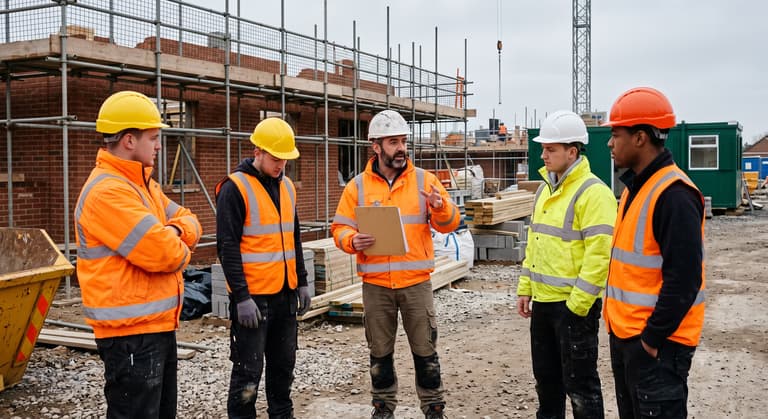
Prepare
Pick one topic and settle on your two or three key points before you walk in. Keep the scope tight. If you can, bring something real with you, whether that is a photo of a hazard from your own site or the piece of kit the talk is actually about. Concrete beats abstract every time.
Deliver
Timing matters. The start of a shift, when people are fresh, works far better than the end of one. Beyond that:
- Explain the hazard and why it matters, using a real example wherever you can.
- Talk through the controls in plain language: what to do, and what to steer clear of.
- Ask open questions. “Where do you see this risk on our site?” gets a much better response than “any questions?”
- Watch the clock. Push much past ten minutes and you have lost the room.
Write it down
Every talk should leave a record. As a minimum, note the date, the topic, who ran it and who was there. If anyone raises a hazard, capture it and give it to someone to fix. This is the step most organisations skip, and it matters enough to come back to below.
What to Talk About: Choosing Your Topics
The single biggest mistake is picking a topic at random. The best ones come straight out of your own workplace.
Look at your own data first. A hazard that keeps surfacing in your near miss reports is a talk waiting to happen, and so is a control that your latest risk assessment flagged as important. Add the jobs that carry real risk in the week ahead, and the seasonal problems that catch people out: ice and poor light in winter, heat and dehydration in summer.
When you do want a starting point, the topics below cover the risks most workplaces return to again and again. Treat them as prompts, not a curriculum.
Topics that apply almost anywhere
- Slips, trips and falls
- Manual handling and lifting
- Choosing and wearing PPE
- Fire safety and evacuation
- Electrical safety
- Working at height
- Hazardous substances (COSHH)
- Housekeeping and clear walkways
- Stress, fatigue and wellbeing
- Violence and aggression at work
- Lone working
- Reporting hazards and near misses
Construction
- Ladders and working platforms
- Excavations and buried services
- Plant and site vehicle movements
- Silica and construction dust
- Hand-arm vibration
- Confined spaces and permits to work
Manufacturing & warehousing
- Machine guarding
- Isolation and lockout/tagout
- Forklifts and pedestrian segregation
- Racking and safe stacking
- Chemical handling and storage
Transport & logistics
- Loading and unloading
- Reversing and manoeuvring
- Load securing
- Driver fatigue and working hours
Care & healthcare
- Moving and handling people
- Infection prevention and control
- Safe use and disposal of sharps
- Lone working in the community
Recording and Evidencing Your Toolbox Talks
Running the talk is only half of it. If you cannot show that it happened, and that anything raised was acted on, you lose most of the benefit, for safety and for compliance alike.
Paper sign-in sheets are the traditional answer, and they beat nothing. But they go missing, they are slow to search, and they tell you very little once you have more than one site or team. When an inspector, an insurer or a client asks you to prove your workforce has been briefed on a particular hazard, a drawer full of loose sheets is a poor place to be looking.
It pays to treat each talk as a record you can actually use.
- Log attendance digitally, so you know exactly who has been briefed and who still needs to be.
- Turn anything raised into a tracked action with an owner and a deadline, not a note in a book no one opens again.
- Line your talks up with your programme of audits and inspections, so the risks you brief on are the same ones you check for on the ground.
This is where a talk stops being a box-ticking exercise. A topic that comes from a real hazard, prompts a fix that someone is accountable for, and feeds back into your next incident reporting review is worth ten that get read out and forgotten.
Making Toolbox Talks Stick
Toolbox talks are cheap to run and easy to neglect. The ones that make a difference get delivered consistently and recorded properly, so that what people raise actually leads somewhere.
That is the part Vatix is built for: capturing what comes up on the front line, turning it into tracked actions, and tying it back to the rest of your safety programme in one place. If you would like to see how that works for your organisation, have a chat with our team.