

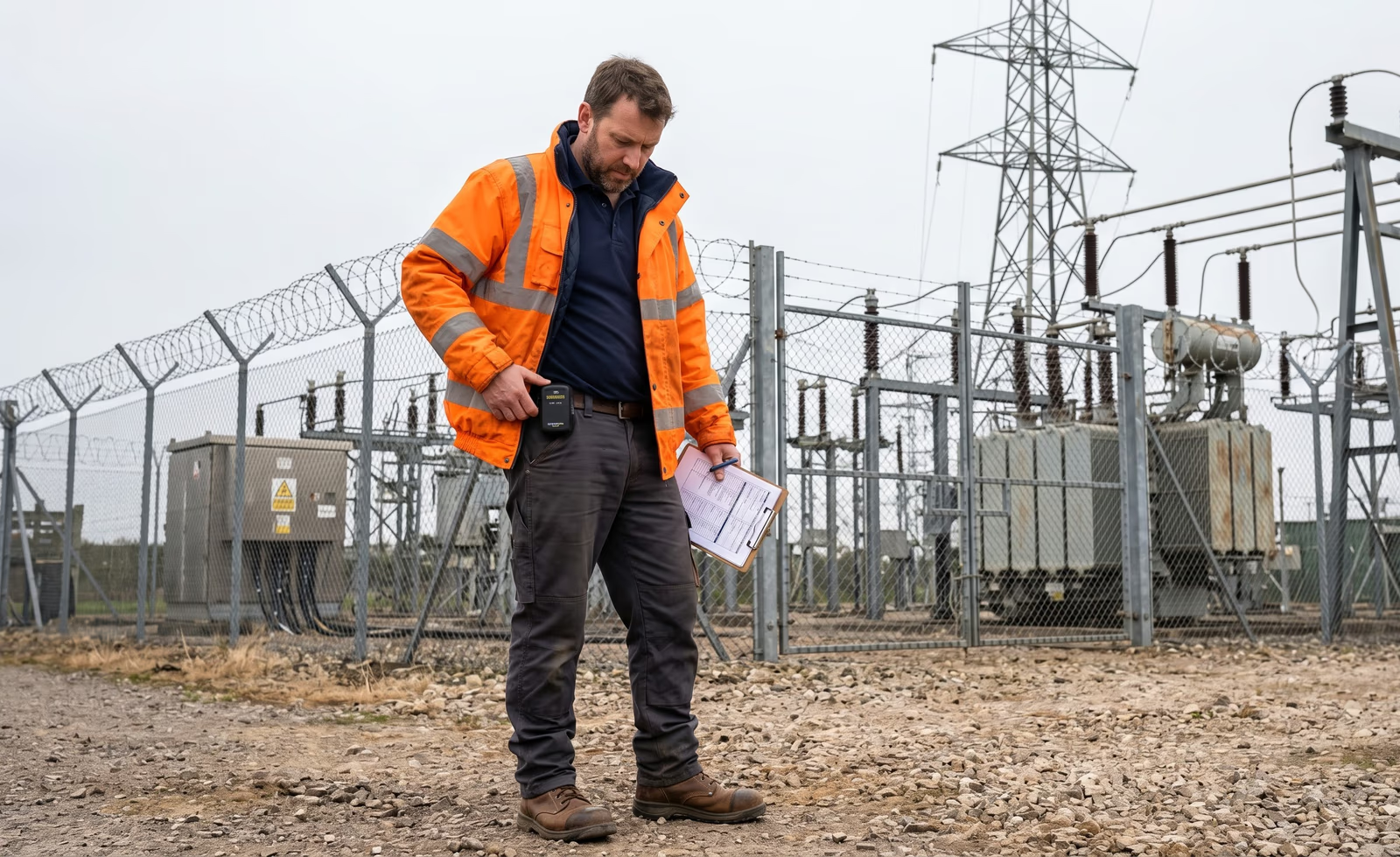
For most teams buying lone worker protection, the choice comes down to a dedicated device or a smartphone app. Both can do the job well, and the right fit depends on the practical realities of where your people work and what they already carry.
What follows is a buyer's-side framework for that decision: the legal and certification baseline that applies whichever route you take, the situations where each option is the stronger pick, and the diligence questions worth asking any supplier before you sign anything.
The legal floor
UK law doesn't treat lone workers as a separate category. They sit under the same duty of care as every other employee. What changes is the risk profile and, in practical terms, the difficulty of keeping an eye on them.
The Health and Safety at Work etc. Act 1974 sets out the overarching duty of care. The Management of Health and Safety at Work Regulations 1999 require employers to assess risks and put suitable controls in place. For lone working specifically, HSE's practical guidance is INDG73, Protecting lone workers: How to manage the risks of working alone, revised in 2020.
The standard most professional buyers look for is BS 8484:2022, the British Standard covering lone worker safety services. It sets requirements across four areas: the functional reliability of the device or app the worker carries, the operational standards of the alarm receiving centre handling alerts, the defined emergency response levels including coordination with the police and ambulance services, and the data privacy controls protecting the worker's personal information. A BS 8484 accredited solution is the evidence a serious H&S team relies on to show it has met its duty of care, and it's what an HSE inspector or insurer will expect to see.
HSE statistics record 689,000 incidents of violence at work in 2024/25, and lone workers in public-facing or enforcement roles carry a disproportionate share of that exposure.
Where dedicated devices win
A dedicated device is hard to beat for one specific job: giving workers a reliable SOS button in places where mobile coverage is patchy or where personal phones aren't appropriate.
Signal reliability. A multi-network roaming SIM lets the device pick whichever carrier has the strongest signal at any moment. A phone locked to one network has dead zones, and a dead zone is where a worker has no protection. For utilities engineers in rural areas or security officers patrolling industrial sites, that single difference often decides the purchase.
Smart fall detection. Cheap fall detection works on a tilt sensor and false-alarms whenever a worker kneels, bends down, or sits still for too long. Better detection looks at real motion patterns and only fires on actual falls. The difference matters because a system that misfires repeatedly stops being trusted, and an untrusted system gets ignored.
Battery life. A device with three to five days of standby gets through a working week without daily charging. A phone that's run flat by lunchtime is no protection at all.
Durability. Lone-worker devices are built for the conditions the workers actually operate in. They're typically IP-rated for water and dust resistance and drop-tested for industrial use, designed to sit on a belt clip or in a uniform pocket without issue. A smartphone in a back pocket isn't rated for the same conditions and costs significantly more to replace when it gets broken.
Indoor positioning. GPS alone struggles indoors and underground. Hybrid positioning combines GPS with Wi-Fi triangulation, so the worker can still be located in those environments.
No-phone environments. Some workplaces don't allow personal phones at all, including clean rooms and certain secure sites. In those settings a dedicated device is the only protection that fits.
Where apps win
An app is usually the right call when your workforce already carries company smartphones and the goal is to extend protection at scale or modernise an existing check-in process.
No hardware to procure. Nothing to buy, distribute, charge, replace, or recover when staff leave. For a 300-user rollout that adds up to meaningful saved overhead.
Higher adoption. The worker is already carrying the phone, so there's no separate device to forget on the kitchen counter. Adoption rates tend to follow.
Lower training overhead. Workers already know how to use a smartphone. A short walkthrough of how to trigger an alert, set a check-in, and confirm peer status is usually enough to get a worker comfortable. A dedicated device introduces new kit and a new behaviour pattern, which means a longer change-management effort and more day-one questions for the H&S team.
Discreet activation. A well-designed app lets a worker trigger an SOS without unlocking the phone. Older designs needed the user to unlock, open the app, and find a button, which is several seconds too slow when someone is under threat.
Timed welfare check-ins. A worker can set a timer for a bounded task, such as "I'm working at height for 20 minutes". If they don't check in when the timer expires, the alert escalates. The check should be picked up by a real ARC operator, not routed to an automated phone menu.
Peer check-ins. Distinct from a timed alert: a feature workers actively use to confirm they're safe after finishing a task, such as arriving home or completing a community visit. It replaces the WhatsApp groups and informal buddy systems many organisations still rely on.
Offline alert caching. An SOS triggered in a basement, lift shaft, or tunnel queues locally and sends as soon as signal returns. Apps that don't handle this lose alerts in exactly the situations where they're most needed.
Cost per seat. Apps are meaningfully cheaper than devices, especially at volume. For a large lower-risk lone-working population (community visits in well-covered areas, hybrid workers, field sales) that's how protection becomes economically feasible to extend to everyone who needs it, rather than only the highest-risk roles.
The questions to ask any vendor
Whichever option you land on, the same diligence questions apply.
On the device. Is it 4G-first with 2G fallback? Does the SIM switch between carriers automatically to find the strongest available signal? What does the fall detection actually use, AI on real motion patterns or a basic tilt sensor? Can staff trigger a test alert to confirm the device is working before they need it? Will it locate a worker indoors?
On the app. Does it have full feature parity on iOS and Android? Does it cache SOS alerts offline and send them when signal returns? Can a worker trigger an alert without unlocking the phone? Are timed welfare check-ins answered by a real operator rather than an automated menu? Does it stay running reliably in the background?
On the Alarm Receiving Centre. Is it BS 8484:2022 accredited? Is it operated in-house or outsourced? Are the operators trained specifically in lone worker protocols? Does data stay in a single system, or pass between vendor and ARC platforms? Are response-time SLAs contractually committed? Is there geographic redundancy?
On the supplier. Are they BS 8484:2022 and ISO 27001 certified? Can they share customer references in your sector? What does onboarding look like in practice, and what's the realistic time from contract to live deployment? Will you have a named account contact, or just a ticketing portal? When a device is faulty or lost, what's the actual turnaround for a replacement?
Conclusion
Vendor diligence matters more than spec-sheet comparisons. BS 8484:2022 and ISO 27001 should be non-negotiable. The ARC should be operated by people trained specifically in lone-worker protocols, and whatever response-time SLAs the contract commits to, you should be able to hold someone to them.
If you want to walk this checklist against what Vatix offers, a short demo is the fastest way through it. We're BS 8484:2022 and ISO 27001 accredited, with 24/7 ARC monitoring behind every device and app deployment.