

The UK health and safety landscape is entering a period of significant change. Between landmark employment legislation, evolving HSE priorities, and rapid technological advancement, 2026 will require EHS professionals to adapt faster than ever.
This isn't a global overview—it's a focused look at what's coming specifically for UK organisations. Whether you manage safety in healthcare, manufacturing, facilities management, or construction, these seven trends will directly affect how you protect your workforce and maintain compliance in the year ahead.
1. The Employment Rights Act Transforms Workplace Safety Duties
The Employment Rights Act 2025 represents the most significant overhaul of UK employment law in a generation, and its implications for health and safety are substantial.
From October 2026, employers will face enhanced obligations around harassment prevention. The existing duty to take "reasonable steps" to prevent sexual harassment becomes a requirement to take "all reasonable steps"—a seemingly small change with major practical consequences. Organisations will need documented risk assessments, comprehensive training programmes, and clear reporting mechanisms to demonstrate compliance.
Perhaps more significantly, third-party harassment liability returns. Employers will become responsible for harassment of their employees by customers, clients, suppliers, and visitors. For public-facing sectors like retail, hospitality, healthcare, and facilities management, this creates new risk assessment requirements and demands proactive safety measures for customer-facing staff.
Other changes affecting EHS teams include day-one rights to statutory sick pay from April 2026, which may increase reporting of minor illnesses and injuries, and enhanced whistleblowing protections for those reporting harassment, effective from the same date.
Action point: Review your harassment policies, incident reporting procedures, and lone worker protections before October 2026. Consider how third-party interactions create risks for your workforce.
2. Mental Health Becomes a Core Safety Discipline
Mental health has moved from the periphery to the centre of occupational health and safety. The HSE's 2023/24 statistics showed that stress, depression, and anxiety accounted for almost half of all work-related ill-health cases—and the numbers remain stubbornly above pre-pandemic levels.
In 2026, expect the HSE to push harder for employers to treat psychological risks with the same rigour as physical hazards. Kayleigh Roberts, HSE's work-related stress policy lead, recently urged employers to move beyond awareness campaigns: "We're asking employers to keep talking—but start doing. Even small changes, like reviewing workloads or improving communication, can make a big difference."
This shift means mental health risk assessments will become standard practice, not optional extras. Organisations should expect greater scrutiny of workload management, working hours, and support mechanisms during inspections. The revised L74 first-aid guidance already calls for businesses to consider mental health first-aid provision alongside traditional physical first aid.
For EHS professionals, this creates both a challenge and an opportunity. Integrating mental health into existing safety management systems—rather than treating it as a separate HR initiative—positions health and safety as central to workforce wellbeing.
Action point: Conduct stress risk assessments using HSE's Management Standards framework. Train managers to recognise early warning signs and integrate mental health checkpoints into regular safety reviews.
3. AI Moves From Buzzword to Practical Safety Tool
Artificial intelligence in EHS has reached an inflection point. According to Verdantix, AI-enabled EHS software is expected to become the norm rather than the exception by 2026. But what does this mean in practical terms for UK organisations?
The most immediate applications are in hazard detection and incident prevention. AI-powered systems can now analyse CCTV footage to identify unsafe behaviours—workers entering exclusion zones, incorrect PPE usage, or near-miss events that might otherwise go unreported. This moves safety monitoring from reactive to proactive.
For organisations drowning in safety data, AI offers a way to surface meaningful patterns. Thousands of incident reports, observations, and audit findings can be categorised and analysed in seconds, identifying correlations that would take human analysts weeks to discover. One practical example: linking overtime patterns to injury rates, or correlating indoor air quality data with absenteeism.
However, the technology brings challenges. Worker surveillance concerns, data protection obligations, and the need for transparent algorithms all require careful navigation. The HSE is expected to increase scrutiny of human-machine interactions and monitoring ethics as these technologies become mainstream.
Action point: Evaluate where AI could add value to your safety processes—incident analysis, compliance monitoring, or predictive risk assessment. Start with clearly defined use cases rather than wholesale platform changes.
4. HSE Reviews Key Safety Regulations
The HSE is conducting a formal review of several long-standing regulations, with potential amendments expected to be consulted on in 2026. The Lifting Operations and Lifting Equipment Regulations (LOLER) and Pressure Systems Safety Regulations (PSSR) are both under examination.
The regulator is specifically seeking evidence on administrative requirements that don't clearly support risk reduction, and areas where regulations may lag behind current practice—particularly around inspection intervals, documentation requirements, and the potential for digital monitoring to replace traditional checks.
For organisations with significant lifting equipment or pressure systems, this creates both opportunity and uncertainty. While potential relaxation of administrative burdens would be welcome, any changes will require updates to procedures, training, and documentation practices.
Separately, the new BS 5839-1:2025 fire alarm standard requires all non-domestic premises to align with updated requirements. This affects fire risk assessments and may require system upgrades across commercial and industrial buildings.
Action point: Respond to HSE consultations where relevant to your operations. Begin reviewing your documentation practices for regulated equipment to identify where digital solutions could improve efficiency.
5. Climate Risk Enters the Safety Conversation
Climate change is increasingly recognised as a workplace safety issue, not just an environmental concern. UK summers are getting hotter, extreme weather events are becoming more frequent, and these changes create tangible risks for workers.
In 2026, expect greater emphasis on heat stress management, particularly for outdoor workers in construction, agriculture, utilities, and logistics. While the UK doesn't currently mandate maximum working temperatures, HSE guidance on thermal comfort is likely to receive renewed attention as extreme heat events become more common.
Flood preparedness and emergency planning for extreme weather events will also climb the agenda, affecting site safety assessments and business continuity planning. For organisations with multiple sites, environmental risks will need consideration alongside traditional occupational hazards.
This trend connects to broader ESG reporting requirements. As sustainability reporting becomes more standardised, organisations will face pressure to demonstrate how environmental and safety considerations are integrated—not siloed into separate functions.
Action point: Include climate-related hazards in your risk assessment process. Review emergency procedures for extreme weather events and consider how environmental factors affect worker welfare.
6. Contractor and Supply Chain Safety Tightens
As businesses rely more on contractors, agencies, and complex supply chains, regulators are tightening expectations around shared safety responsibilities. The trend is clear: organisations can no longer treat contractor safety as someone else's problem.
The Employment Rights Act includes provisions extending employment protections to workers in supply chains, while the Procurement Act 2023 (effective from February 2025) requires health and safety considerations to be integrated throughout public procurement processes—from tendering through to contract management.
For organisations working in construction, manufacturing, and logistics, this means enhanced due diligence on contractor safety standards and clearer accountability for risks across supply networks. Grey areas where no one takes ownership of hazards will face closer scrutiny.
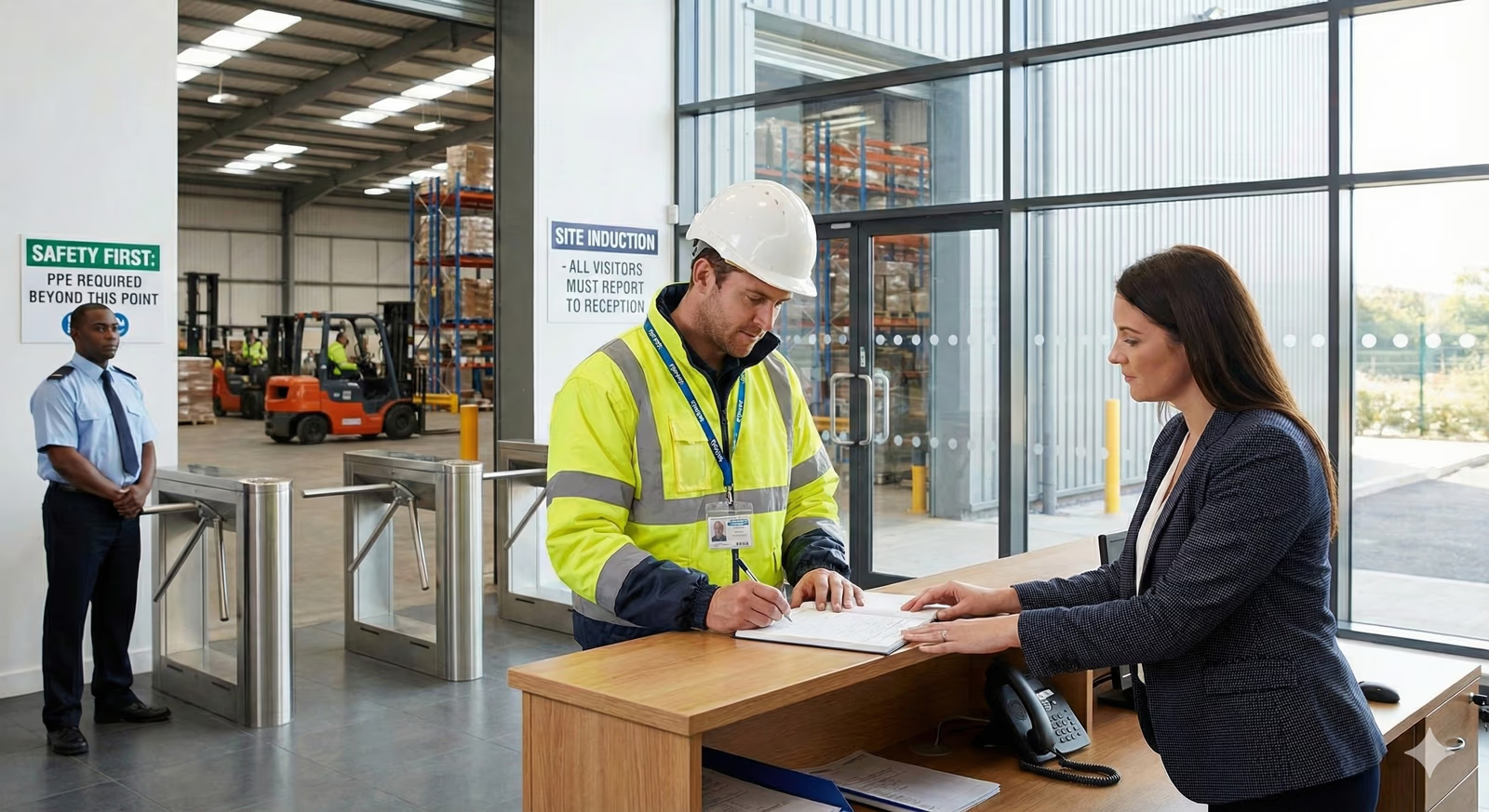
Practically, this affects contractor onboarding, site inductions, monitoring arrangements, and incident reporting. Organisations need visibility of safety performance across their extended workforce, not just direct employees.
Action point: Review contractor management procedures. Ensure safety requirements are clearly specified in contracts and that monitoring arrangements are in place to verify compliance.
7. Cybersecurity Becomes a Safety Risk
As operational technology and IT systems converge, cybersecurity is emerging as a workplace safety issue—not just a data protection concern.
A compromised building management system could disable fire alarms or emergency lighting. A hacked access control system could trap workers in hazardous areas. Ransomware affecting industrial control systems could cause equipment to behave unpredictably. These aren't hypothetical scenarios; they're logical consequences of increasingly connected workplaces.
For EHS professionals, this means safety-critical systems need to be part of cybersecurity risk assessments—and vice versa. The traditional separation between IT security and operational safety is becoming untenable. Expect closer collaboration between EHS teams, facilities management, and cybersecurity functions as organisations recognise that digital vulnerabilities can create physical hazards.
Wearable technology adds another dimension. Devices that monitor worker location, fatigue, or biometric data can genuinely enhance safety—but they also create data protection obligations and potential concerns about surveillance. Getting the balance right between safety benefits and worker privacy requires clear policies and genuine consultation.
Action point: Identify safety-critical systems that depend on digital infrastructure. Work with IT and facilities teams to ensure these are included in cybersecurity risk assessments and business continuity planning.
Preparing for 2026
The common thread across these trends is integration. Mental health connects to physical safety. Employment law intersects with risk management. Technology enables new approaches but demands new controls. Climate considerations affect site safety. Supply chain complexity requires extended accountability.
For EHS professionals, this creates pressure—but also opportunity. Organisations that take a joined-up approach to worker protection, treating safety as central to business operations rather than a compliance exercise, will be better positioned to navigate the changes ahead.
The regulatory environment is evolving, workforce expectations are rising, and technology is transforming what's possible. Staying ahead means acting now—reviewing policies, updating risk assessments, and building the systems that will support compliance and worker wellbeing in 2026 and beyond.
If you're looking to strengthen how your organisation captures, tracks, and learns from workplace incidents, explore how Vatix's incident reporting software can help you build a more proactive safety culture.
Book a demo today and learn more about how Vatix can help you improve workplace safety and compliance.