


Choosing the best EHS platform (environment, health & safety) is about more than ticking a compliance box. For many organisations, it’s the operating system for safety: a single place where incidents are reported and learned from, audits and inspections are planned and completed, risks are identified and controlled, and actions are tracked to closure. When this work is fragmented across spreadsheets, inboxes, and point tools, leaders struggle to see emerging issues, workers lose confidence that hazards will be addressed, and improvement stalls.
A modern EHS platform centralises these workflows and the data behind them so teams can:
- Capture events quickly and consistently (often on mobile)
- Standardise processes with configurable forms and workflows
- Surface trends with dashboards and analytics
- Assign accountability with clear actions and due dates
- Demonstrate compliance with clean, auditable records
The result is better visibility, faster follow‑up, and a stronger safety culture – without adding administrative burden. It also supports growth: as operations scale or regulations change, configuration and reporting can adapt instead of forcing another tooling switch.
Below we've shared a shortlist of EHS platform vendors operating in the UK which you can map to your organisation’s priorities.
Top EHS Platforms
Vatix
Overview
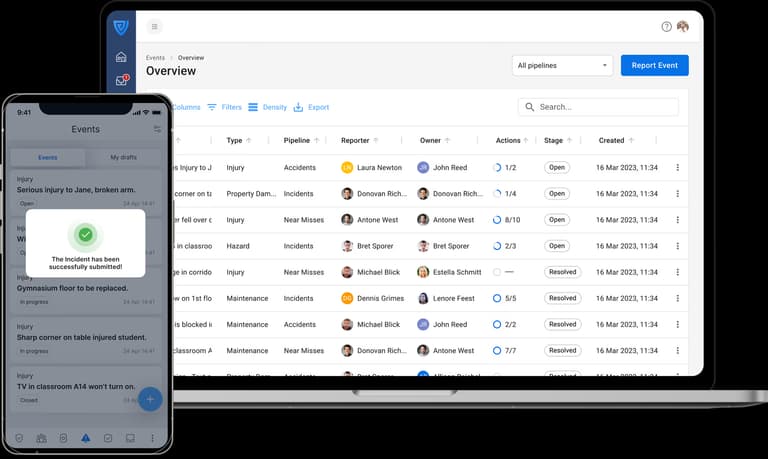
Vatix is a connected, customisable platform for managing safety, quality, and compliance across incidents, audits, actions, and risks.
Advantages
Vatix is highly customisable and simple to set up and use. It also provides incident reporting and AI-assisted analytics as part of an integrated suite that includes incidents, audits, actions, and risk management.
Considerations
Vatix is cloud‑based only and does not offer a self‑hosted deployment option.
Best for
Organisations that want a flexible, customisable EHS platform that is quick to roll out and unifies incidents, audits, actions, and risk in one cloud-based solution.
Evotix
Overview
Evotix is a cloud-based EHS platform that covers core workflows such as incident reporting, audits and inspections, action management, and analytics, with an emphasis on worker engagement.
Advantages
Evotix is configurable, allowing teams to tailor forms and workflows, and it is designed to promote worker engagement across everyday safety tasks.
Considerations
Compared with the largest enterprise suites, Evotix has a smaller enterprise footprint, which may be a consideration for very complex, global rollouts.
Best for
Organisations that want an EHS system with strong worker‑engagement features and a straightforward cloud rollout.
EcoOnline
Overview
EcoOnline focuses on safety management and chemical safety, offering incident reporting, risk assessments, and audit tools, and is widely used across the Nordics, the UK, and Europe.
Advantages
EcoOnline is known for ease of use and leadership in chemical safety, helping teams standardise processes without heavy training overheads.
Considerations
The platform offers narrower breadth than some large enterprise suites, so teams seeking an all‑in‑one system may find coverage gaps.
Best for
Teams that prioritise chemical safety and an easy‑to‑use interface for day‑to‑day safety management.
Ideagen
Overview
Ideagen is a governance, risk, and compliance (GRC) vendor whose EHS capabilities sit within a broader GRC platform. Its mobile app is mature and supports global deployments.
Advantages
The EHS solution benefits from Ideagen’s GRC focus and a mature mobile application, which can support regulated, distributed operations.
Considerations
Complex implementations may require more in‑depth configuration and longer time to value.
Best for
Organisations that need EHS within a wider GRC approach and value a mature mobile experience for global teams.
Evalu‑8
Overview
Evalu‑8 is a UK‑focused platform that combines HR with built‑in health and safety modules, including incidents, risk assessments, RAMS, audits, and training tracking.
Advantages
It offers a straightforward pricing structure and out‑of‑the‑box templates and workflows, making it quick for smaller teams to get started.
Considerations
As an HR‑first product aimed at SMEs, Evalu‑8 may face scalability limitations compared with dedicated enterprise EHS suites.
Best for
SMEs that want simple HR plus health and safety tooling with ready‑made templates and minimal setup.
VelocityEHS
Overview
VelocityEHS is an EHS/ESG platform with modules for health & safety, risk, and sustainability reporting, serving both mid‑market and enterprise customers.
Advantages
Users get a unified EHS/ESG experience with strong usability and the confidence of a large user base.
Considerations
Depth can vary by module, so teams should validate specific feature needs during evaluation.
Best for
Organisations looking for an approachable EHS/ESG suite with broad adoption and solid usability.
Donesafe
Overview
Donesafe (part of HSI) is a modular EHS platform offering a library of apps and a no‑code builder so teams can model forms and workflows for a wide range of industries and company sizes.
Advantages
The large module library and simple user experience help teams configure the system to their needs without heavy development.
Considerations
Compared with enterprise suites, advanced EHS/ESG breadth can be limited, so complex programmes may need to confirm coverage.
Best for
Teams that value no‑code flexibility and a broad app library to tailor workflows quickly.
Cority
Overview
Cority is an EHSQ platform with comprehensive coverage across safety, environmental, and quality management, and is known for depth in Occupational Health.
Advantages
It provides a broad suite with robust capabilities, particularly in Occupational Health, to support complex governance requirements.
Considerations
Deployments can be configuration‑heavy, so organisations should plan resources for setup and ongoing administration.
Best for
Large or highly regulated organisations that need an extensive EHSQ suite with strong Occupational Health capabilities.
Summing up
No matter what your selection criteria are – feature breadth, rollout speed, reporting depth, or governance – the most important outcome is a safer, more compliant operation. An effective EHS platform is one of the simplest, lowest‑friction ways to centralise incident reporting, audits, risk, and actions so nothing falls through the cracks.
Getting started doesn’t have to be complex. With a modern, cloud‑based solution, teams can capture incidents on mobile, schedule inspections, and track corrective actions with clear ownership – so you gain visibility quickly and maintain momentum as you scale.
As you’ve seen above, there are several credible EHS platforms on the market. But at Vatix, the focus goes beyond point solutions. Vatix brings incidents, audits, actions, and risk into one integrated platform, with AI‑assisted analytics to help you spot trends and drive continuous improvement.
From day‑to‑day reporting to structured audits and risk controls, an end‑to‑end system makes it simpler to stay on top of governance and compliance without adding administrative burden.
If you’re looking for more than a basic safety tool – if you want a complete platform to support your organisation’s EHS goals – get in touch with the Vatix team for a walkthrough and see how it could fit your workflows.
Frequently asked questions about EHS platforms
What is an EHS platform?
An EHS platform helps organisations manage health & safety, environmental compliance, and related governance. Typical workflows include incident reporting, audits & inspections, risk assessments, and action management.
What should I look for when evaluating?
Focus on coverage of core workflows, ease of configuration, mobile experience, and reporting. If you operate in regulated environments, also check hosting, authentication, and data residency options.
How should I compare shortlists?
Map each vendor to 3–5 measurable criteria that matter most to you (for example: implementation effort, mobile readiness, and governance features). Then run a time‑boxed pilot and score results against those criteria.